Blog

  • How to Use Evernote for “GTD”

    How to Use Evernote for “GTD”

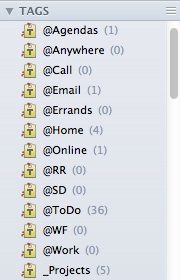
    Evernote GTD Context Tags“Getting Things Done” (or GTD) is a popular productivity method first made popular by David Allen’s book in 2001. The GTD system utilizes an “action management system”. It’s most often used for incoming information like emails, texts, and phone messages.

    The GTD flow goes like this:

    1. Examine each item
    2. Is it actionable?
    3. If not,
      • trash it, or
      • move it to a “someday/maybe” list, or
      • move it to a reference list.
    4. If it is actionable, determine if it will take less than 2 minutes. If yes, take care of the action. If not, delegate it or schedule it for later.

    Use Evernote notebooks for both actionable and non-actionable lists

    Create an Evernote notebook for “Someday/Maybe” items and another one for “Reference”. Your actionable items can go into either a “Next Actions” notebook or a “Waiting For” notebook. Use reminders to help you to schedule your actions.

    Use Evernote tags for context

    David Allen also recommends organizing your “Next Actions” by context. His examples are “Agendas”, “Anywhere”, “At the computer”, “Errands, “Home”, and “Office”. You can use Evernote tags for context. So, for example, when you’re checking your “Next Actions” notebook and you’re not at home, search for the “Anywhere” and “Office” tags.

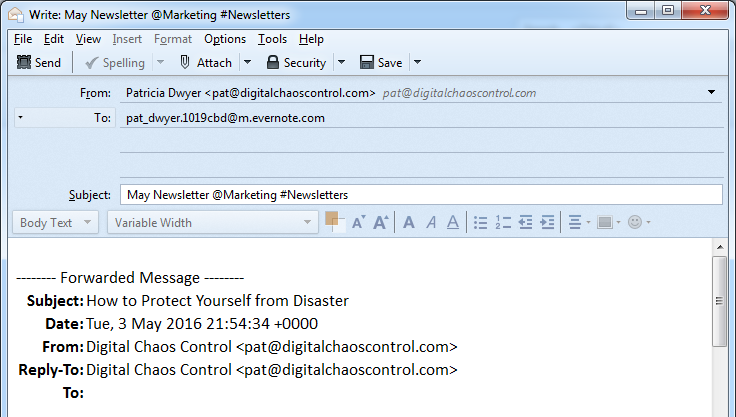
    Notes in your “Next Actions” list should have the name of the action in the title, tags with the contexts, and a reminder set for follow-up. If you have an Evernote Plus account, you can also forward emails to your “Next Actions” notebook. Do this by forwarding to your Evernote email addresses and appending @Next Actions to the title, followed by #<tag1> #<tag2>, etc. (See my blog post here about Evernote and email: How to Use Evernote to Keep Email Organized.)

    Have a routine

    Your daily routine should include time to go through your incoming information using the GTD method. You will also need time daily to check your “Next Items” and “Waiting For” notebooks. Update tags & reminders and remove notes as you complete them. You should also schedule time weekly to check your “Someday/Maybe” notebook.

    This is a simplified version of the GTD method, but I believe strongly in techniques that are easy to follow.

    Here’s a detailed method by AppAdvice: Learn How to Boost Your Productivity, and another by Darren Crawford: My Simple GTD Evernote Combo

    Get the “Controlling the Chaos” Newsletter and receive a free PDF download
    “Drowning in Email – A Lifeline for Communications Overload”
    * indicates required


  • How to Use Evernote to Keep Email Organized

    How to Use Evernote to Keep Email Organized

    Evernote Organized Email

    Email can be difficult to deal with in an efficient and organized way.

    Keeping emails organized into folders can help you to find the right email conversation, as can using your email search tools. But email correspondence is just one part of the story. If you’re trying to put together the history of working with a client, for example, you’ll have to search separately for related client files and notes. It’s not difficult to do, but it does take time and your search may come up with lots of unrelated information.

    My previous blog post on email management here: 4 Steps to Becoming More Responsive can help. A better method may be to use a tool to keep email organized along with related information. Evernote is a great tool for this. (You can read more about using Evernote for managing client information here: 7 Tips to Manage Client Info.)

    Also, if you’re organizing a trip, you can keep the research, photos, itineraries, email correspondence, and receipts in one notebook. If you’re managing a project, you can keep the tasks, notes, and email correspondence in another notebook.

    How to save your emails to Evernote

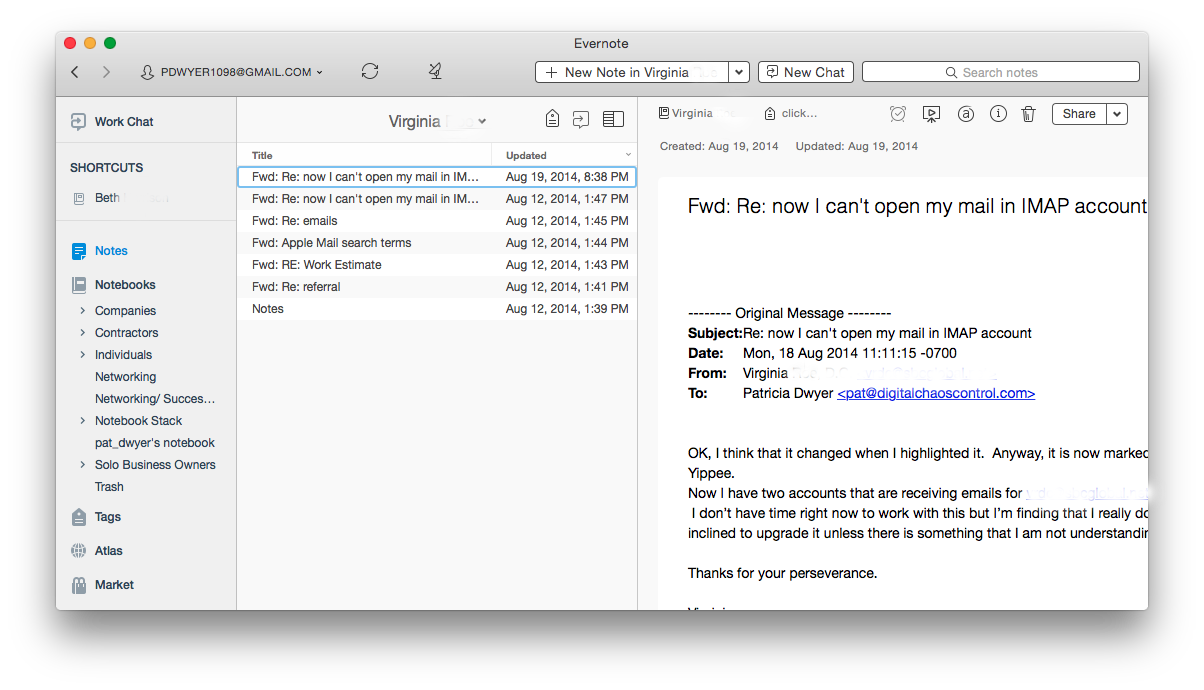
    The most efficient way is to cc: your Evernote email address in your email correspondence. This will put those emails in your default Evernote notebook. You can leave them there and use search to find those emails later, or you can go into Evernote and move them into other notebooks. You can also add those emails later by forwarding to your Evernote email address.

    When you cc: or forward an email you can target a specific notebook by adding “@<notebook name>” to the end of the subject line. You can add tags by using #<tag> and reminders by using !<date>.

    Emailing to Evernote requires an Evernote Plus paid account. Evernote also has a free version, but you’ll have the extra step of copying your email, going to your Evernote app, creating a new note, and pasting the email into it.

    How to find your Evernote email address

    When you sign up for an Evernote Plus account, you get an associated email address (something like username.XXX@m.evernote.com). You can find the address by going to your account info under “Tools” in the PC or “Help” on the Mac.

    Get the “Controlling the Chaos” Newsletter and receive a free PDF download
    “Drowning in Email – A Lifeline for Communications Overload”
    * indicates required


  • 8 Tips to Manage Client Information Using Evernote

    8 Tips to Manage Client Information Using Evernote

    Evernote NotebooksIn my previous blog post about Using Evernote, I referred to using Evernote to manage client information.

    Evernote is a great tool for creating memos, checklists, and reminders about clients. It’s also a good way to keep your client information all in one place and keep it organized.

    Here’s how to use Evernote to manage your client information:

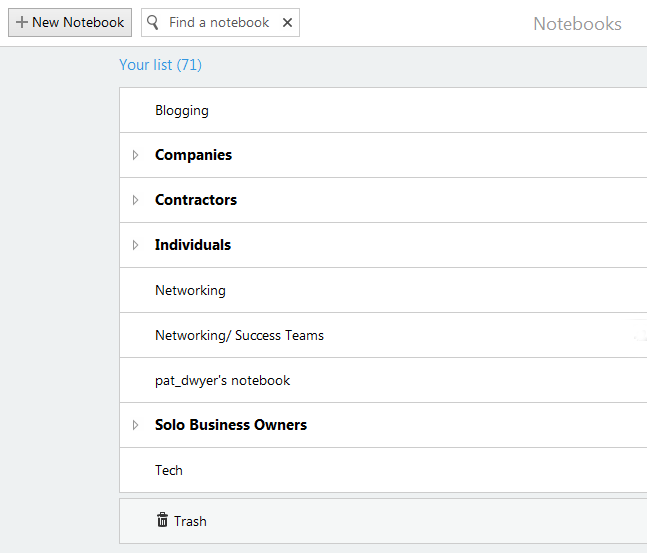
    1. For each client, create a new notebook.
    2.  

    3. Evernote notebooks can be “stacked”, meaning that you can create one level of hierarchy. I suggest a notebook stack for each type of client or type of work.
       
      For example, if you are an interior designer, you may have a notebook stack titled “Window Treatments”, another titled “Room Layouts”, etc.
    4.  

    5. Share the notebook with collaborators and/or clients.
    6.  

    7. As you work with the client, update notes or add new notes. If you have related documents and/or photos, you can add them to the note as attachments. 
    8.  

    9. Referenced web sites go into the notebook. Install the Evernote Web Clipper extension into your browser. This will allow you to “clip” the page, or an article on the page, and save it to your client notebook.
    10.  

    11. Email correspondence goes into the notebook. When you sign up for an Evernote Plus account, you get an associated email address (something like username.XXX@m.evernote.com). You can CC: your Evernote account on your client email correspondence or you can forward the email later. 
       
      If you add “@<notebook name>” to the email subject line, then Evernote will even put the email into the specified notebook.
    12.  

    13. Use tags to help find things. For example: If you want to track how your clients found you, you could tag your client notes with a “referred by:<>” tag. Evernote lists your tags on the sidebar.
    14.  

    15. Add reminders to notes so that you’ll remember to follow up with your clients.


    Using Evernote as a simple CRM (Customer Relationship Management) system.

    Here’s one method to do so:

    • Create a notebook stack for each month.
    • Create a notebook daily:
      • Use the Evernote mobile app to capture business cards or contact information for the day’s leads and opportunities.
      • Add notes for those leads and opportunities and reminders so that you’ll remember to follow up.

    Another method could be to create one notebook called “Leads” with contact information and reminders.

    Here’s a blog post from “101 Conversations” on this subject: How to Use Evernote as a Relationship Management Tool

    You can also use a dedicated CRM tool and integrate it with your Evernote client notes. I use Insightly for this, but there might be other CRM tools that integrate with Evernote as well.

    http://www.insightly.com

    Now you can have all of your client information – notes, files, photos, websites, emails in one place! And Evernote has great search and is continuing to improve it. You can search within your notes & emails and, if you are a Premium user, then you can search within documents.

    A note of caution: Keep in mind that Evernote is a cloud application. Anything on the Internet is only as secure as your password, so be sure to use strong passwords and to update them regularly.

    Get the “Controlling the Chaos” Newsletter and receive a free PDF download
    “Drowning in Email – A Lifeline for Communications Overload”
    * indicates required


  • Three reasons to use Evernote for Team Collaboration

    Three reasons to use Evernote for Team Collaboration

    Evernote for Business

    Evernote is a great organization system because you can organize your notes, documents, photos, and emails all in one place.

    As an Evernote user, you have the option of sharing notes and notebooks with others. But for true collaboration with team members that gives you a shared work space, admin controls, and more, you need the Evernote for Business plan.

    Your team members can add research notes, to-dos, points for follow-up, web clippings, etc. Members can initiate chat sessions for team discussions. (Work chat allows your team to cut back on email discussions, gets them chatting in real time, and helps to get them focused on the task at hand).

    Here are the advantages to using Evernote for team collaboration:

    • It’s a tool that is already well known.
    • The usage model is well understood.
    • You get to take advantage of Evernote’s organization and search features.

    Evernote for Business costs $12.50 per user per month. Start by setting up an account under your admin email. Then add a work domain. This allows employees in the same domain to be automatically added to your business account without approval.

    It’s a great tool for upfront research.

    Evernote isn’t a project management platform. You probably won’t be using it to create assignments, tasks, and schedules (although you can create checklists and reminders). You also won’t be using it to develop code. But it’s great for upfront work.

    You can gather requirements, document research, and communicate with team members.

    It’s also a great way to keep all project work in one place. You can use Evernote’s search function to find keywords, tags, documents, and emails.

    Get the “Controlling the Chaos” Newsletter and receive a free PDF download
    “Drowning in Email – A Lifeline for Communications Overload”
    * indicates required


  • How to Recharge Your Brain Like an Evernote Employee

    How to Recharge Your Brain Like an Evernote Employee

    Evernote Barista

    If you ever drive through Redwood City CA on Highway 101, you may notice the Evernote headquarters right beside the freeway.

    Redwood City is better known as an enterprise technology hub, home of Oracle headquarters and its spin-offs. (You’ll see the Oracle headquarters down the road with its distinctive buildings. But, unless you work with enterprise databases, you probably won’t get that flash of recognition that you experience when you see that elephant logo.)

    Evernote has only a few hundred employees at its Redwood City headquarters. The company has a unique corporate culture. As Alex Bernson writes on sprudge.com, a coffee culture blog, Evernote encourages informal mixing among its employees by offering barista training and enabling them to take a weekly shift in the lobby coffee bar. (Read the article here: A Different Kind of Coffee Break).

    “The response to Evernote’s unique coffee program has been quite positive, with many employees reporting that by taking a “break” to make coffee for their coworkers, they were able to clear their heads, using a different part of their brains to get creative juices flowing.”

    Evernote: Where Everybody Knows Your Name

    The article made me think of the old TV show “Cheers”. In that show, Sam Malone held out behind the bar and forged close connections with Boston locals.

    I think that this company approach to giving their employees a way to take a break and interact must work well, because they’ve created a great organizational tool for the rest of us.

    So perhaps we could all take a lesson from Evernote.

    Get out there, have coffee (or cocktails) with co-workers or others in your industry, and get your brain recharged.

    Get the “Controlling the Chaos” Newsletter and receive a free PDF download
    “Drowning in Email – A Lifeline for Communications Overload”

    * indicates required


  • How to Get More Organized With Writing

    How to Get More Organized With Writing

    Evernote for Writing
    Screenshot courtesy of www.Evernote.com

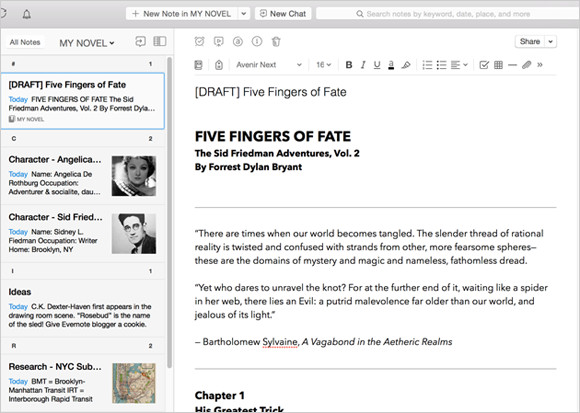
    If you’re a writer, whether it’s creative or business, you know that the bulk of a writing task is doing research and/or making notes. When you sit down to compile that research and start your writing, it helps to have those notes, web clippings, photos, etc. organized.

    Having a good organization system for your writing can help so much with getting inspired, getting started, and saving time.

    I suggest using Evernote for this. (You can read my blog post on Evernote here: Use Evernote For a New Level of Organization).

    There are multiple ways to use Evernote to organize your research. You can start with a notebook for “Research” with tags for each type of research. This is helpful if you won’t know the structure of your writing ahead of time. If you do have some structure in mind, it may be more helpful for you to have notebook stacks. For example, you could have a stack for each chapter, or a stack for each article.

    Use the Evernote app on your computer and mobile devices to write up your notes. You can add web clippings using the Evernote “Web Clipper” add-on in your internet browser and use the Evernote app on your smartphone or tablet to take photos.

    Tags can be very helpful to search for all of your research on a particular subject.

    You can assign multiple tags to each note, web clipping, or photo. For example, if you’re writing a piece about wellness and you find a web site dedicated to healthy eating, you can clip it and tag it “wellness”, “eating”, “diet”, etc.

    Using Evernote for research gives you a tool to keep all of your research in one place. Evernote’s great search tool can help you to bring up references quickly so that the most tedious part of writing goes quickly and smoothly, leaving you more time for creativity and even more research!

    Are you a fiction writer? Here’s a great article on Lifehacker: How to Use Evernote for Writing Fiction.

    Need help with Evernote? Contact me.

  • How to Organize Using Evernote Notebooks

    How to Organize Using Evernote Notebooks

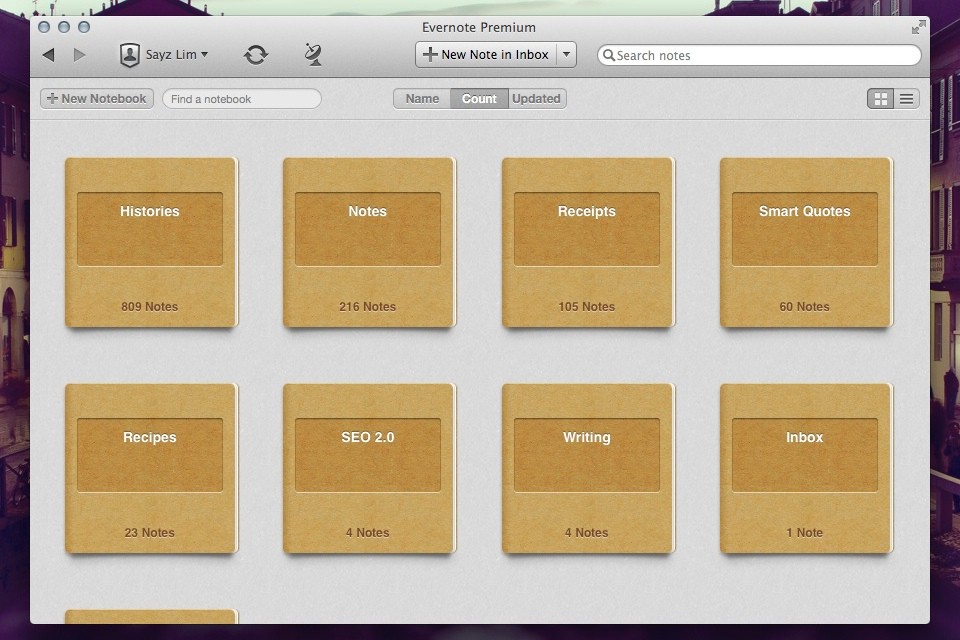
    Evernote Notebooks

    Evernote Notebooks – the First Level of Organization


    If you’ve read my blog post on Evernote here: Use Evernote For a New Level of Organization then you know that it’s a great way to organize your digital information.

    Navigating the Evernote interface is dependent on the platform that you’re using it on. I have a desktop PC, a MacBook, and a smartphone – all of which are running Evernote. (You can also use Evernote through their web interface.) Since my main computer is a PC desktop, I typically do my Evernote notebook organization using the PC application. Then, with my organization in place, I can take notes, tag notes, add photos & web clippings – targeting a particular notebook no matter which platform I’m using.

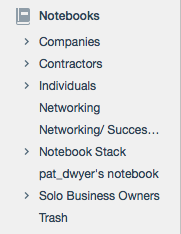
    Notebooks can be “stacked”, meaning that you can create one level of hierarchy. You may have a “clients” stack for example, with a notebook for each client underneath, or a “research” stack, with a notebook for each area of research.

    Here’s how to create Evernote notebooks:

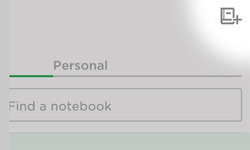
    Click on “Notebooks” in the sidebar. Click on “New Notebook” at the top (or on the below symbol if you’re using a smartphone app/web interface).

    Evernote New Notebook

    Once you’ve added the notebook, it will show up under “Notebooks” in the sidebar in alphabetic order. Select that notebook so that any new notes will go into it.

    Here’s how to manage Evernote notebooks stacks:

    In the PC or Mac application, when you click and drag one notebook to another then Evernote will create a “Notebook stack”, which you can rename. Or you can right-click on a notebook for a list of options, including “Add to stack” or “Remove from stack”.

    In iOS:

    1. Navigate to your notebook list view.
    2. Tap Edit in the upper right screen.
    3. Select the information icon (“i”) next to the notebook you would like to move to your stack.
    4. Tap Stack.

    In Android:

    If you press and hold on a notebook name, you’ll get a menu with a list of options, including “Move to stack”.

    Keeping Evernote notebooks is like keeping stacks of file folders on your desk, except with no clutter! Use your notebooks to store notes, files, photos, web clippings, and emails so that everything is in one place making it easy to find what you need, when you need it.

    Need help with Evernote? Contact me.

  • Use Evernote For a New Level of Organization

    Use Evernote For a New Level of Organization

    Evernote

    Have you heard of Evernote?

    It’s hard to tell you what it is in one sentence. It’s a note-taking application, you can use it to create to-do lists, you can use it to organize files into notebooks, you can use it to scan documents and make them searchable, you can use it to “clip” and save web pages, etc. The list goes on and on…

    Whether you’re someone who likes to keep digital information organized or whether you’re someone that is organizationally challenged, then Evernote may be the tool for you. You can keep almost anything organized with Evernote – by keeping related items in one place.

    If you’re working with projects, you can use Evernote to organize, share, and collaborate on your projects. If your business involves working with clients, and you’d like a new way to manage those clients, you can use Evernote to keep your client information in one place and to write yourself memos, checklists, and reminders about that client.

    Here’s how to use Evernote for organization:

    1. For each new project or client, create a new notebook.
       
      A note of caution: Keep in mind that Evernote is a cloud application. Anything on the Internet is only as secure as your password, so be sure to use strong passwords and to update them regularly.
    2.  

    3. Share the notebook with collaborators and/or clients.
    4.  

    5. As you work with the project or client, update notes or add new notes. For documentation and or photos, add it to the note as an attachment.
       
      Depending on how you work, you may find that you’re looking at web pages and that you want to save them for reference. Don’t use bookmarks. Install the Evernote Web Clipper extension into your browser. This will allow you to “clip” the page, or an article on the page, and save it to your project or client notebook.
    6.  

    7. Email correspondence goes into the notebook. When you sign up for an Evernote Plus account, you get an associated email address (something like username.XXX@m.evernote.com). This means that you can CC: your Evernote account on your client email correspondence, or you can forward the email later.
       
      If you add “@<notebook name>” to the email subject line, then Evernote will even put the email into the specified notebook.
    8.  

    9. Use tags to help find things. When you tag a note, you can search for all notes with the same tag. For example: If you want to know how your clients found you, you could tag your client notes with a “referred by:<>” tag, and then you can search for all client that have the “referred by: website” tag.
       
      You don’t have to use search to find tags; Evernote conveniently lists all of your tags on the sidebar, so you can just click on it. Here’s a blog post with more information on using tags: Using Evernote the Right Way.

    Now you can have all of your project or client information – notes, files, photos, websites, emails in one place!

    Wait, it gets better – Evernote has great search and is continuing to improve it. You can search within your notes & emails and, if you are a Premium user, then you can search within documents.

    You can search on titles, keywords, or tags, of course, but Evernote supports more advanced search as well.

    • You can search by date – use the format “created:yyyymmdd” or “updated:yyyymmdd”. Even better, search for a date range: use the format “created:day-x” or “updated:day-x”.
    •  
      For example, if you want to search for all notes that you created about infant formula in the last month, enter the following in the search bar: “infant formula” created:day-30.
       

    • If you want to see the notes that you created using your smartphone, enter the following in the search bar: source:mobile.*.
    •  

    • If you want to see just the webpages that you’ve clipped using the Evernote Web Clipper, enter source:web.clip.
    •  

    • If you’re using the Evernote Macintosh app, you can use plain English for your search. For example “Notes about infant formula in the last month”.

    Evernote is just one tool for information organization, but it’s an increasingly popular one and it continues to evolve.

    Try it out and let me know how it works for you! Contact me

    Get the “Controlling the Chaos” Newsletter and receive a free PDF download
    “Drowning in Email – A Lifeline for Communications Overload”
    * indicates required


  • Are you a desktop piler or closet piler?

    Are you a desktop piler or closet piler?

    Pile of Files

    If you don’t keep your digital files organized, chances are you are not as productive and efficient as you could be.

    Are you a desktop piler?

    Then you may also be someone who automatically saves files to the desktop.  This means that you have icons all over the place. Your computer desktop is much less visible than your actual desk desktop, so it may not bother you at all, except when you need to find something.

    Are you a closet piler?

    You may save documents to the application’s default location (usually “Documents” on the Macintosh and “My Documents” on the PC). When you browse to that location on your computer, you will see a long list of documents.

    When you know what to search for, file organization is not really an issue. But you can’t always remember the name of the file that you need. A combination of search techniques and good organization is what serves us best. Use search when you know that right terms. Browsing can be faster if you have good organization.

    Start first with defining the best organization method for you.

    If you work with projects, you might want to start with top-level project folders. Use sub-folders for each type of document. An example for a house remodeling contractor would be a top-level folder named “221 Main St.”, with sub-folders for each sub-contractor. If you’re a consultant, you might want to start with top-level client folders.

    Your organization system might consist instead of document types. For example, you might have a top-level “Marketing” folder, with sub-folders for “Presentations”, “Flyers”, “Brochures”, “Blog Posts”., etc.

    The best organization system for you will depend on how you look for things. The important thing is to start with a system, use it consistently, and to adjust it as needed.

    Here’s a nice post from Seagate, the disk drive company, on file organization: Organizing Your Digital Files.

    Get the “Controlling the Chaos” Newsletter and receive a free PDF download
    “Drowning in Email – A Lifeline for Communications Overload”

    * indicates required


  • Inbox Zero Eliminates Overload – by Michael Neuendorff

    Inbox Zero Eliminates Overload – by Michael Neuendorff

    Inbox Overload

    Do you suffer from email overload?

    Terrible, isn’t it? Every time you open your Inbox the email just flows in like a waterfall.

    The challenges with managing email are myriad. Here are a few:

    • Feeling overwhelmed before even getting started
    • Losing track of an email and asking the sender to send the email again. (Now there are 2 copies in the Inbox!)
    • Difficulty prioritizing
    • Looking at, but not dealing with emails. This becomes an unproductive pattern.
    • Email seems more like a curse than a benefit

    Can you relate? I worked with many people over the years that suffer from email overload. It’s a key reason why they feel chronically disorganized and unable to focus on what really matters each day. The email just keeps coming.

    Here’s my true confession: I used to be that way.

    I would routinely let my Inbox balloon to about 2,500, then I’d start cleaning up email for a period, usually over a holiday break, and get back down to 50 or less. After a few years of this, I decided enough was enough and devised some strategies that would work for me.

    This was more than 2 years ago. Since then I’ve never had more than 100 emails in my Inbox. As I write this I have 19 emails in my Inbox. Here are my 6 rules I follow to manage email.

    1. Move everything non-essential out of your Inbox. What I mean is to have a separate email address for personal email, which includes email from your bank, insurance company, restaurants you like, etc. This puts only business-related email into your primary Inbox. Second-level business email should go into folders via Rules or into another Tab ala Gmail. I use the Gmail tabbed approach.
    2. Be militant about unsubscribing to email you don’t want from Senders you no longer care about. Too many people are lazy about unsubscribing thinking, “I might like the next email I get.” (Even though they really don’t.) If you see value, keep it. If you don’t, throw it out. Simple rule: You should read all the email you get.
    3. Block time out for email cleaning at least every other day. I make sure I have a few hours to mow through my Inbox every few days. I am not willing to let email pile up so I make it a priority.
    4. Don’t use your Inbox as a reminder system. People leave email in their Inbox to remind them to do things. Use a Task Manager like Asana instead. Use email as a communication tool. That’s all.
    5. As soon as you deal with an email, file it away. I file email like crazy all the time. As soon as I reply to someone, I file their email. After they reply, I file it again. Over and over, file, file, file. By the way, this requires that you have file folders for everything and everyone.
    6. Delete email constantly. If I’m not filing it, I’m deleting it. Just as with Rule #5, refuse to let email linger.

    If you’ll follow these 6 rules you’ll have a fighting chance at Inbox Zero.

    The reason you want to do this is because it will lift a huge weight off your shoulders and you’ll realize the true power of email as the powerfully efficient communication and moneymaking tool that it is.

    Once you’re there, vow to never go back to the way it was. Ever.

    If you’d like more tips about dealing with email, get these two books: Getting Things Done by David Allen, and The Ultimate Sales Machine by Chet Holmes. These books cover much more than email, but their tips on this topic were instrumental to my approach.

    Michael Neuendorff is an acclaimed Business Coach and Sales Trainer. Learn more about his business at http://www.buildandbalance.com.